WESTERN AREA FIRE BRIGADE
The Western Area Fire Brigade came into operation on the 8th May, 1948 under the Fire Services Act,1947 covering the counties of Argyll, Bute and Renfrew, and the burghs of Greenock, Paisley and Port Glasgow. The Brigade continued until Regionalisaton on 16th May, 1975 when part of it went into the new Highland and Islands Fire Brigade and the rest helped form the new Strathclyde Fire Brigade.
Headquarters
| 1948 to 1964 | 12 Johnston Street, PAISLEY, Renfrewshire. |
| 1964 to 1975 | 5 Thornhill, JOHNSTONE, Renfrewshire. |
Firemasters
| 1948 to 1961 | Firemaster R. Bowman O.B.E. G.I.F.E. |
| 1961 to 1968 | Firemaster Joseph Hartil |
| 1968 to 1975 | Firemaster Robert Herbert M.B.E. |
Stations
| 1948 | 1975 | |||
| RENFREW | ||||
| Paisley | WT/RT | Paisley | WT/RT | |
| Renfrew | WT/RT | Renfrew | WT/RT | |
| Johnstone | WT/RT | Johnstone | WT/RT | |
| Darnley | WT | Closed 1970 | ||
| New station 23/9/1970 | Clarkston | WT | ||
| Barrhead | RT | Barrhead | WT/RT | |
| Port Glasgow | WT/RT | Port Glasgow | WT/RT | |
| Greenock | WT/RT | Greenock | WT/RT | |
| Gourock | RT | Gourock | RT | |
| BUTE | ||||
| Rothesay | RT | Rothesay | RT | |
| Millport | RT | Millport | RT | |
| Brodick | RT | Brodick | RT | |
| Lamlash | RT | Lamlash | RT | |
| Unit was her 1955 | Lochranza | Vol. | ||
| Unit started 1967 | Lagg | Vol. | ||
| Unit at Whiting Bay in 1953 moved to Blackwaterfoot 1971 | ||||
| Unit started 1971 | Blackwaterfoot | Vol. | ||
| ARGYLL | ||||
| Oban | RT | Oban | RT | |
| Campbeltown | RT | Campbeltown | RT | |
| Dunoon | RT | Dunoon | RT | |
| Lochgilphead | RT | Lochgilphead | RT | |
| Bowmore | RT | Bowmore | RT | |
| Tobermoray | RT | Tobermoray | RT | |
| Kinlochleven | RT | Kinlochleven | RT | |
| Inveraray | RT | Inveraray | RT | |
| Tarbert | RT | Tarbert | RT | |
| Appin | Vol. | Appin | Vol. | |
| Dalmally | Vol. | Dalmally | Vol. | |
| Lismore | Vol. | Lismore | Vol. | |
| Luing | Vol. | Luing | Vol. | |
| Strachur | Vol. | Strachur | Vol. | |
| St. Catherines | Vol. | St. Catherines | Vol. | |
| Lochgoilhead | Vol. | Lochgoilhead | Vol. | |
| Colintraive | Vol. | Colintraive | Vol. | |
| Kames | Vol. | Closed 1970 | ||
| Tighnabruaich | Vol. | Tighnabruaich | RT | |
| Carradale | Vol. | Carradale | Vol. | |
| Unit was here 1955 | Kilmelford | Vol. | ||
| Strontain | Vol. | Strontain | Vol. | |
| Lochaline | Vol. | Lochaline | Vol. | |
| Kilchoan | Vol. | Kilchoan | Vol. | |
| Unit was here 1955 | Glenborrodale | Vol. | ||
| Unit started 1968 | Acharacle | Vol. | ||
| Unit started 1971 | Ardgour | Vol. | ||
| Salen (I of Mull) | Vol. | Salen | Vol. | |
| Bunessan | Vol. | Bunessan | Vol. | |
| Unit started between 1960 and 1963 | Craignure | Vol. | ||
| Unit started 1956 | Isle of Iona | Vol. | ||
| Cornaighmore | Vol. | Closed and moved to Balemartin 1972 | ||
| Scarnish | Vol. | Scarnish | Vol. | |
| New unit 1972 | Balemartine | Vol. | ||
| Arinagour | Vol. | Arinagour | Vol. | |
| Port Ellen | Vol. | Port Ellen | Vol. | |
| Unit started at Portnahaven between 1960 and 1963 Closed 1973 | ||||
| Unit moved here from Portnahaven 1973 | Port Charlotte | Vol. | ||
| Craighouse | Vol. | Craighouse | Vol. | |
| Isle of Colonsay | Vol. | Isle of Colonsay | Vol. | |
| Isle of Gigha | Vol. | Isle of Gigha | Vol. | |
| Unit at Salen (Ardnamurchan) 1955 Closed 1971 |
Notes
The call sign for the Western Area Fire Brigade Control was M2GR.
The following stations were built:-
| 27/10/1955 | Brodick | |
| /1959 | Inverarary | |
| /1959 | Bowmore | |
| () | 24/6/1960 | Greenock |
| 1961 | Campbeltown | |
| /1963 | Barrhead | |
| () | 28/7/1965 | Rothesay |
| 26/11/1965 | Renfrew | |
| 1966 | Dunoon | |
| 6/12/1967 | Tighnabruaich | |
| /1/1968 | Johnstone | |
| /5/1968 | Tarbert | |
| /5/1968 | Lochgilpheadt | |
| (14) | 7/7/1969 | Port Glasgow |
| 23/9/1970 | Clarkston | |
| () | 22/11/1972 | Gourock |
| /1/1973 | Paisley | |
| () | 25/7/1973 | Millport |
| 1975? | Oban |
New Headquarters at Thornhill, Johnstone 1963 replaced headquarters at Paisley Fire Station.
£90,000 HEADQUARTERS FOR JOHNSTONE
The Western Area Fire
Headquarters, which cost £90,000 to build, is now directing fire operations from
Johnstone to places as far away as Oban and Tobermory.
All the staff have now moved into this magnificent modern building, from which
all fires in Renfrewshire, Bute and Argyll are controlled over an area of 3,500
square miles. The fire control room, the nerve centre of the entire fire
fighting force in the western area quickly and efficiently issues instructions
to fire stations, stipulating how many fire brigades should go to the various
fires in the area.
There is very little possibility of any mistake being made in the number of fire
appliances sent out to a fire. One of the girls who works in the control room
explained: -
“Every street in Renfrewshire is down in the attendance list. Whenever we
receive a call here, we find out where the fire is and look up the street in the
attendance list. Having found out this information, we proceed to direct the
necessary appliances to the fire.
“Although this method would appear to be completely infallible, it sometimes
happens that we receive a call from a housewife who thinks that her whole house
is in flames. We may decide from the answers she gives us in her excitement to
send several fire engines, and when they arrive at the house the firemen find
that it was only a pot which had boiled over on the cooker, and that she had
managed to put it out by herself.
“As often as possible,” continued the girl with the fires of the whole area at
her fingertips, “we in the Control Room handle the fires without bothering the
Firemaster at all. We do not feel that the responsibility we have is too great,
and it gives us a certain pleasure to feel that we are doing such a worthwhile
job."
The staff in the ultra modern, abstractly carpeted office have nothing but
praise for their new surroundings. The spacious rooms with contemporary style
desks and comfortable chairs, provide an amenable setting for the important work
that is carried on within the walls. The officials pursue their individual
business in their curtain clad offices of which they are very proud and make
sure that any crisis which arises will be dealt with immediately.
The personal needs of the occupants of the building have not been overlooked, as
there is a streamlined kitchen, complete with stainless steel unit and sparkling
electric cooker. Some of the girls also take advantage of the facilities of the
kitchen to make their meals at lunchtime. Nor do they have to carry their meal
more than a few yards from the cooker, since the kitchen is fully equipped as a
dining room with formica covered tables and suitable chairs.
Mr Joseph Hartil, Firemaster of the Western Area, said, “In this project we have
the area headquarters, administration centre and fire control. Behind the
administrative block progress is being made on the area stores and workshops
which are not yet completed.
“Although there will not be a fire station here in the future, we have acquired
a site in King’s Road for the proposed fire station. The headquarters at the
Thorn will not be opened formally, but the Western Area Joint Committee will
perform an unofficial opening ceremony on November 25.”
<PHOTO> Firemaster Joseph Hartill. Wearing the Queen’s Fire Service medal which
was presented to him at the opening of the new Barrhead Fire Station, is
Firemaster Joseph Hartill.
<PHOTO> Two girl operators seated at the vast control panel in the new Western
Area Fire Brigade Headquarters.
(Paisley and Renfrewshire Gazette. 6th November, 1964. Page 11.)
WESTERN AREA FIRE BRIGADE
WESTERN AREA FIRE BRIGADE
Area Headquarters
5 Thornhill
JOHNSTONE
Renfrewshire
TO ALL MEMBERS OF THE DEPARTMENTAL COMMITTEE.
VISIT TO WESTERN AREA FIRE
BRIGADE
TUESDAY, 24th October, 1967
May I extend a warm welcome to the
members of the Committee on the occasion of their visit to the Brigade. I trust
that the weather will be kind so that you may see, in comfort, a fair
representation of the towns and villages within the Area. It is intended to pass
or visit Fire Stations at Darnley, Barrhead, Paisley, Greenock, Port Glasgow and
Headquarters, all in Renfrew County, and Dunoon in the County of Argyll.
In the course of your visit your escort will be at your disposal to meet any
wishes you may have on route.
Yours sincerely,
J Hartill
Firemaster.
WESTERN AREA FIRE BRIGADE
The Western Area Fire Brigade was
established on 16th May, 1948, and is administered by a body
corporate by the name of Western Fire Area Joint Committee with a common seal
and power to hold land.
The Joint Committee consists of 20 members appointed annually in May, by the
fire authorities, as follows :-
County Council of Renfrew 7
County Council of Argyll 3
County Council of Bute 1
Town Council of Paisley 4
Town Council of Greenock 4
Town Council of Port Glasgow 1
The Chairman of the Joint Committee,
Doctor J. W. Macfarlane, D.L., J.P., Ph.D., W.H.Sc., M.I.E.E.,M.I. Mech.E.,
R.R.S.E., has held this office since the Fire Brigade was established and is now
the longest serving Chairman in Scotland. The Clerk and the Treasurer to the
Joint Committee are the County Clerk and County Treasurer, County Council of
Renfrew, respectively.
The Joint Committee meets bi-monthly, the meetings being held, in rotation, in
premises of the Constituent Authorities, with one additional special estimates
meeting held normally in the County of Renfrew. Other special meetings are held
as and when necessary. This arrangement meets the general approval of all
members.
FIRE BRIGADE AREA, STATIONS Etc.
The Brigade covers the Counties of
Renfrew, Argyll and Bute, including the large Burghs of Paisley, Greenock and
Port Glasgow. With an area of some 3,533 square miles, the population is
426,971, the rateable valuation £10,676,386 and the Fire Brigade Rate 9.2d.
Brigade Headquarters are situated a Thornhill, Johnstone, Renfrewshire, and
include the Brigade Control Room, Workshops and Stores. There are 7 wholetime
Stations, 14 retained Stations and 32 volunteer Stations in the Brigade Area.
Administrative and operational control of the Brigade is exercised from Brigade
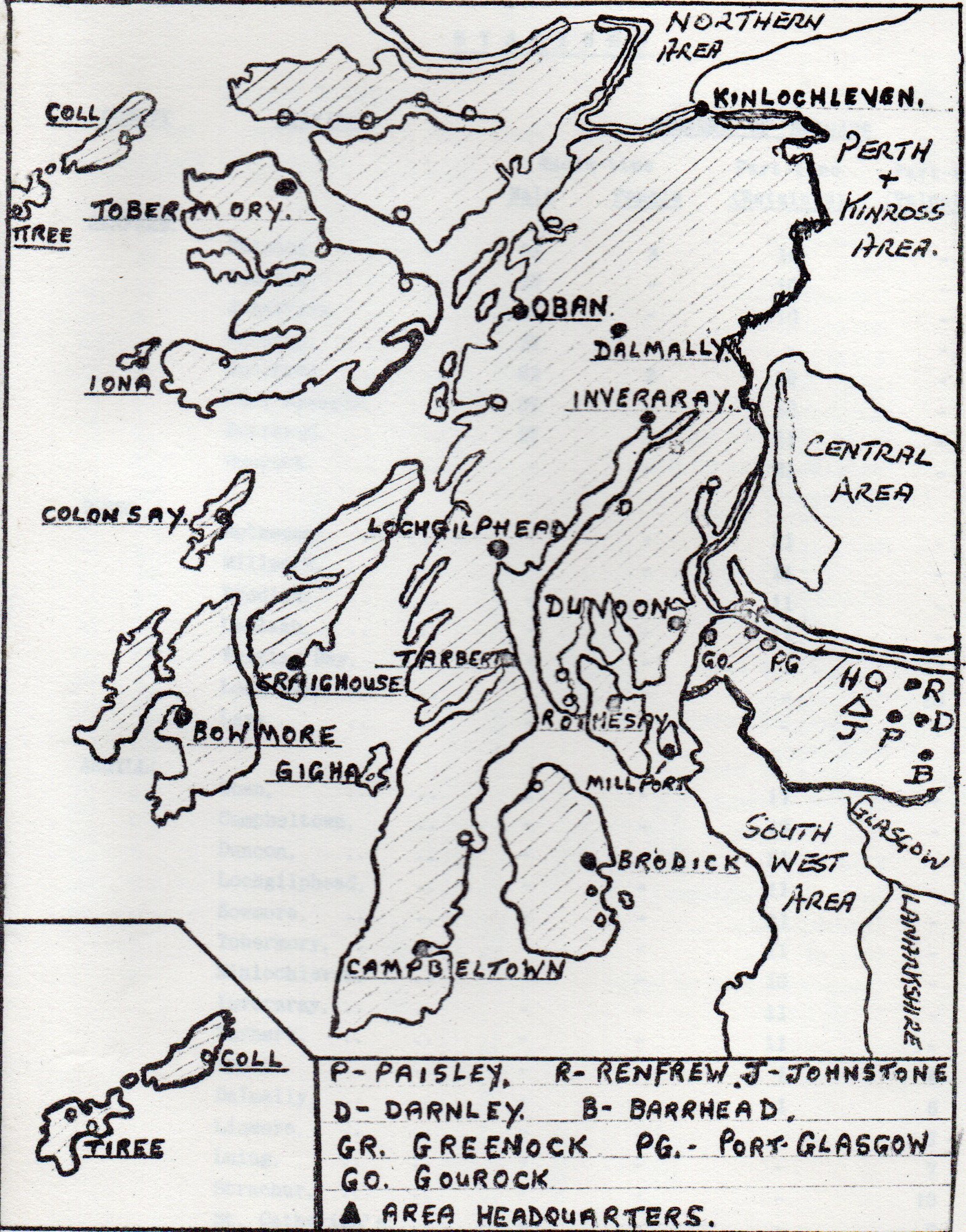
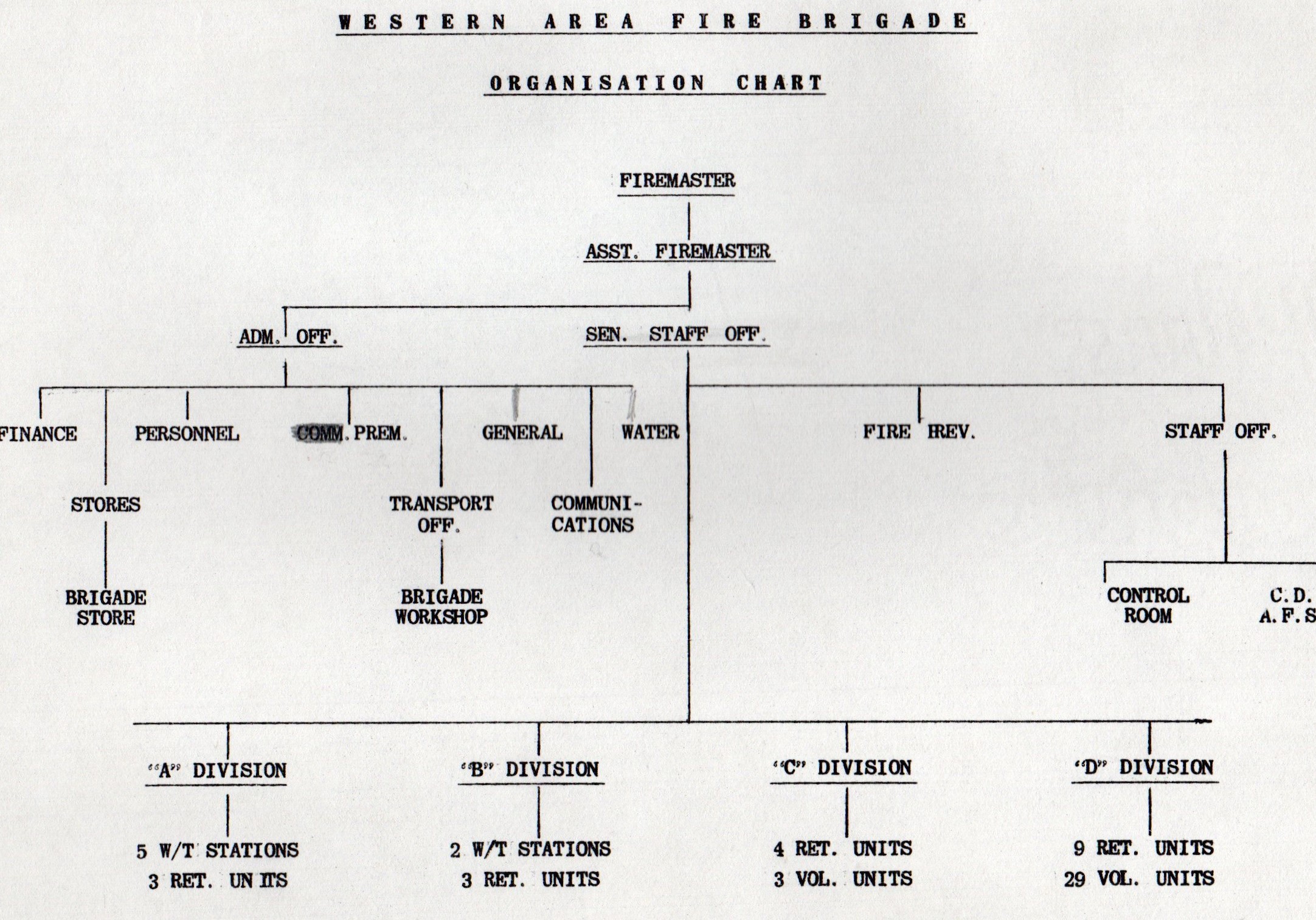
Headquarters. The Area is divided into 4 Divisions, vis., “A” Division
covering mainly East Renfrewshire; “B” Division, West Renfrewshire; “C” Division
the County of Bute; “D” Division, the County of Argyll (including the Inner
Hebrides). A sketch plan of the Area and the organisational plan is attached as
appendices.
FIREMASTER
The Firemaster has considerable
latitude in the general handling of the Brigade and has absolute authority with
regard to the operational efficiency. He attends all meetings of the Joint
Committee, who meet to discuss and determine policy and to deal with such
matters as staffing, pensions, conditions of service, appliances and equipment,
capital projects, etc.
PERSONNEL
The County of Renfrew is covered mainly
by wholetime members of the Brigade but the Counties of Argyll and Bute rely
entirely on retained and volunteer firemen under the supervision of a wholetime
Divisional Officer and one Station Officer. (Approval has been given for the
appointment of a second Station Officer to improve Officer cover and training).
DUTY SYSTEM
In common with many other Brigades,
difficulty has been experienced in recruiting men with the desired
qualifications resulting in the Brigade being considerably undermanned. In
consequence the Joint Committee brought into operation from 1st
September, 1967, an extended availability system which permitted members to do 8
hours duty in excess of the standard duty week of 48 hours. This is allowing the
Brigade to function with a smaller and more efficient establishment, and at the
same time is permitting all members of the Brigade to increase their earnings
considerably.
RESIDENTIAL OFFICERS
All residential officers perform 96
hours duty per week except the Assistant Firemaster who is conditioned to 120
hours per week. Generous arrangements have been made to allow those officers
considerable freedom of movement whilst on duty and a good standard of housing
is provided.
RELATIONS WITH OTHER BRIGADES
Relations with other Brigades are
excellent both on the operational and in the personal field. Agreements have
been made under Sections 2 and 12 of the Fire Services Act, 1947, with six
adjoining Brigades to provide reinforcements and mutual assistance on request.
In Scotland the arrangements on a “knock for knock” basis without the need for
involved financial adjustments. The six Brigades with whom agreements have been
made are – City of Glasgow, South Western, Lanarkshire, Central Area, Northern
Area and Perth and Kinross.
APPLIANCES AND EQUIPMENT
The Joint Committee makes provision in
the Annual Estimates for the replacement of obsolete appliances and equipment
based on a ten year programme of requirements and in this sphere the brigade is
very well equipped to deal with any emergency.
PREMISES
Since 1948, 13 new fire stations have
been built, including Headquarters, 8 of these being within the past 4 years, to
replace adapted and out-of-date buildings. Plans for another 2 have been
approved but it will be 3 or 4 years yet before the Joint Committee are able to
complete their modernisation programme.
FIRE PREVENTION
The Fire Prevention Department officers
are authorised inspectors by the Fire Authority and carry out all duties
required by the Fire Services Act, 1947, The Factories Act, 1961 and the
Offices, Shops and Railway Premises Act, 1963.
CONCLUSION
It is hoped that this booklet may be of
interest to the members of the Departmental Committee and that it may be helpful
to them in understanding the geographical layout of the Western Fire Area.
|
|
|
|
APPENDIX |
|
|
|
||
|
|
|
|
STATIONS |
|
|
|
||
|
|
|
|
|
|
|
|
||
|
COUNTY |
STATIONS |
|
|
|
MEMBERS OF BRIGADE |
|
||
|
|
|
|
Wholetime |
|
Part-time |
Part-time |
||
|
|
|
Male |
|
Female |
(Retained) |
(Volunteer) |
||
|
RENFREW |
Paisley |
63 |
|
3 |
10 |
|
||
|
|
Renfrew |
27 |
|
|
10 |
|
||
|
|
Johnstone |
27 |
|
|
10 |
|
||
|
|
Darnley |
27 |
|
|
|
|
||
|
|
Greenock |
61 |
|
3 |
10 |
|
||
|
|
Port Glasgow |
27 |
|
|
10 |
|
||
|
|
Barrhead |
27 |
|
|
11 |
|
||
|
|
Gourock |
|
|
|
21 |
|
||
|
|
|
|
|
|
|
|
||
|
BUTE |
Rothesay |
|
|
|
21 |
|
||
|
|
Millport |
|
|
|
11 |
|
||
|
|
Brodick |
|
|
|
11 |
|
||
|
|
Lamlash |
|
|
|
11 |
|
||
|
|
Whiting Bay |
|
|
|
1 |
12 |
||
|
|
Lochranza |
|
|
|
|
10 |
||
|
|
Lagg |
|
|
|
|
7 |
||
|
|
|
|
|
|
|
|
||
|
ARGYLL |
Oban |
1 |
|
|
17 |
- |
||
|
|
Campbelltown |
|
|
|
17 |
- |
||
|
|
Dunoon |
|
|
|
21 |
- |
||
|
|
Lochgilphead |
|
|
|
11 |
- |
||
|
|
Bowmore |
|
|
|
11 |
- |
||
|
|
Tobermory |
|
|
|
11 |
- |
||
|
|
Kinlochleven |
|
|
|
18 |
- |
||
|
|
Inveraray |
|
|
|
11 |
- |
||
|
|
Tarbert |
|
|
|
11 |
- |
||
|
|
Appin |
|
|
|
1 |
6 |
||
|
|
Dalmally |
|
|
|
1 |
6 |
||
|
|
Lismore |
|
|
|
- |
7 |
||
|
|
Luing |
|
|
|
- |
7 |
||
|
|
Strachur |
|
|
|
- |
10 |
||
|
|
St. Catherine's |
|
|
|
- |
7 |
||
|
|
Lochgoilhead |
|
|
|
1 |
6 |
||
|
|
Colintraive |
|
|
|
|
7 |
||
|
|
Kames |
|
|
|
|
10 |
||
|
|
Tighnabruaich |
|
|
|
1 |
11 |
||
|
|
Carradale |
|
|
|
1 |
6 |
||
|
|
Strontain |
|
|
|
|
7 |
||
|
|
Lochaline |
|
|
|
|
7 |
||
|
|
Kilchoan |
|
|
|
|
7 |
||
|
|
Salen (Mull) |
|
|
|
|
7 |
||
|
|
Bunessan (Mull) |
|
|
|
1 |
6 |
||
|
|
Cornaigmore (Tiree) |
|
|
|
|
7 |
||
|
|
Scarnish (Tiree) |
|
|
|
1 |
6 |
||
|
|
Aringour (Coll) |
|
|
|
|
7 |
||
|
|
Port Ellen (Islay) |
|
|
|
|
8 |
||
|
|
Portnahaven (Islay) |
|
|
|
|
11 |
||
|
|
Craighouse (Jura) |
|
|
|
|
7 |
||
|
|
Colonsay |
|
|
|
|
9 |
||
|
|
Gigha |
|
|
|
|
7 |
||
|
|
Kilmelford |
|
|
|
|
7 |
||
|
|
Salen (Ardmurchan) |
|
|
|
|
7 |
||
|
|
Glenborradale |
|
|
|
|
7 |
||
|
|
Iona |
|
|
|
|
7 |
||
|
|
Craignure (Mull) |
|
|
|
|
8 |
||
|
|
Acharacle |
Added to list in pencil no numbers |
||||||
MAIN INDEX 1948 INDEX